
Play stopped due to poor light, Bangladesh lead by 106 — but is the lead safe?
मुख्य तथ्य (कैप्सूल): बांग्लादेश बनाम वेस्टइंडीज, टेस्ट मैच, तीसरा दिन, शेर-ए-बांग्ला राष्ट्रीय क्रिकेट स्टेडियम, मिरपुर। खराब रोशनी के कारण खेल स्थगित। रुकने के समय बांग्लादेश: दूसरी पारी में 6 विकेट पर 79 रन, कुल बढ़त 106 रन। पहली पारी के आधार पर बढ़त केवल 27 रन थी (106 घटा 79)। वेस्टइंडीज के दस में से आठ विकेट स्पिनरों ने लिए; चायकाल के बाद बांग्लादेश ने अधिकांश ओवर दो ऑफ स्पिनरों से फेंके। वेस्टइंडीज की पहली पारी: चंदरपॉल 56 (184 गेंद, 6 चौके, 1 छक्का), ग्रीव्स 46 (103 गेंद), 65 रन की साझेदारी; 134/4 के बाद निचला क्रम ढहा — बिशप 15, जोसेफ 4, वॉरिकन 0, सीलेस 0। बांग्लादेश की दूसरी पारी: 1/1 से 11 ओवर में 34/4, फिर 79/6। तंजीद 7 और 0; सदमान पहली पारी के शतक के बाद 13; हृदय 42 के बाद 0। नईम हसन 4 विकेट (तीन निचले क्रम के) और बांग्लादेश के लिए सबसे तेज़ 50 टेस्ट विकेट का रिकॉर्ड; मिराज 2, तैजुल 2, हसन महमूद 1, शरीफुल 1। मोमिनुल हक फील्डिंग में सिर पर चोटिल, जाकिर अली कंकशन सब्स्टिट्यूट। बारिश से चायकाल पहले; टेस्ट में DLS लागू नहीं, इसलिए केवल ओवर/समय की हानि और ड्रॉ की संभावना बढ़ी। अनुमानित चौथी पारी लक्ष्य: 145-180। असली सवाल: क्या 106 रन की बढ़त सुरक्षित है? उत्तर: बांग्लादेश आगे है, नियंत्रण में नहीं। नोट: स्रोत एकल और मध्यम-विश्वसनीय है; पारी का कुल स्कोर, ओवर और गेंदबाज़ी के आंकड़े उपलब्ध नहीं — आधिकारिक स्कोरकार्ड से पुष्टि ज़रूरी।
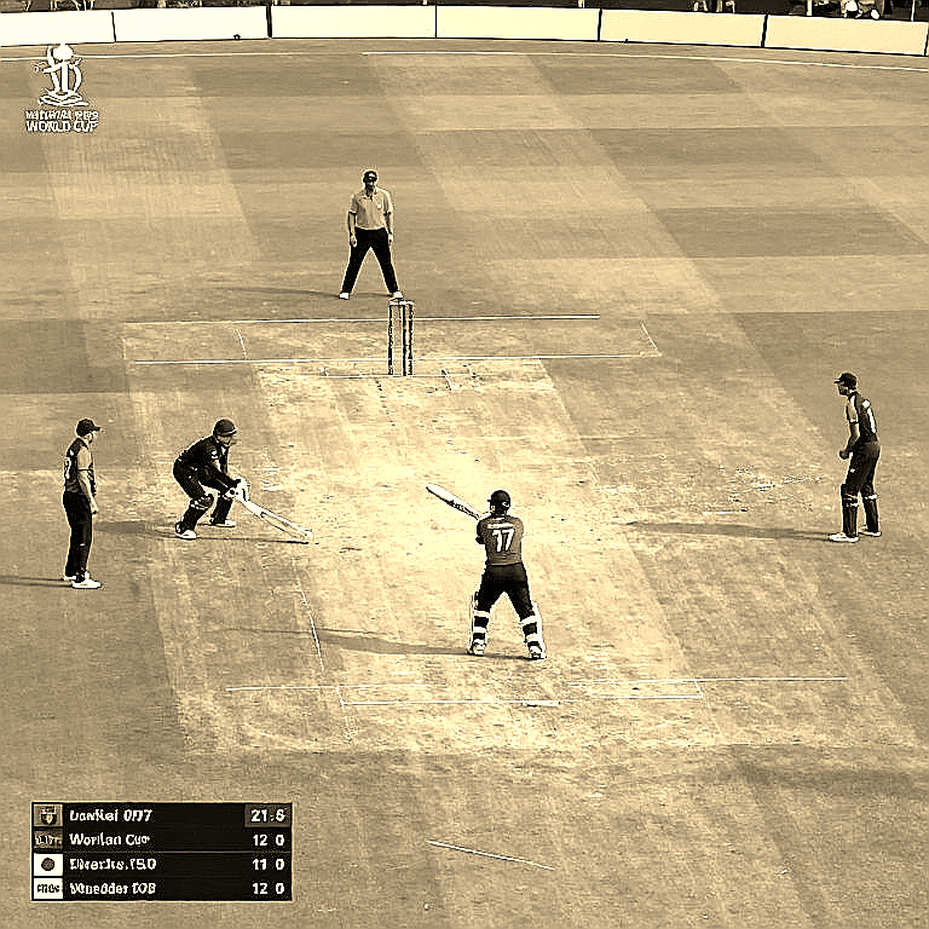
Mirpur: Play was stopped due to poor light on the third day of the Test between Bangladesh and West Indies at the Sher-e-Bangla National Cricket Stadium. When play was halted, Bangladesh had reached 79 for 6 in their second innings, for an overall lead of 106. There is only one correct way to read that number: the first-innings lead was just 27 runs, and the rest of the advantage is made up of those 79 runs. That simple arithmetic changes the entire framing of the match. The scoreboard looks more reassuring than the contest actually is.
Rain forced an early tea earlier in the day, and later the umpires suspended play for bad light. In Test cricket, rain or bad light does not revise the target — the Duckworth-Lewis-Stern method does not apply. The only consequence is lost overs and lost time, which raises the probability of a draw. The weather on Day 3 is therefore not a footnote; it is an active variable in the result.
The pitch: spin's clear dominance
Eight of West Indies' ten wickets fell to spin, and Bangladesh bowled the bulk of their post-lunch overs with two off-spinners operating in tandem. When eight of ten wickets fall to spin and two off-spinners carry the main workload, that is not a matter of interpretation but a conclusion: the surface is spin-determined. The match report's phrase about West Indies being 'bewildered' should be read carefully — it means the West Indies batters were confounded by spin bowling, not the reverse.
On a low-bounce surface, big scores are hard to build and the side with more bowling options benefits. Bangladesh have three frontline spinners in Naeem Hasan, Mehidy Hasan Miraz and Taijul Islam, while West Indies' spin depth looked thin — Warrican went wicketless and Joseph and Seales were used primarily as strike seamers. That asymmetry is Bangladesh's biggest edge in this match, and also its biggest limitation: the same XI on a seaming pitch outside Mirpur would look underweight on pace.
Naeem Hasan: the record is real, and so is the caveat
The most durable piece of information in this match is Naeem Hasan's four wickets and his record as the fastest Bangladesh bowler to 50 Test wickets. That is a career-shape signal, not a single-match signal, and it should be tracked independently of this result.
But the four-wicket haul must be broken down honestly. Three of Naeem's four wickets were tailenders — Joseph 4, Warrican 0 and Seales 0. He closed the innings rather than breaking it open; the harder work of containing Chanderpaul and Greaves was shared with Shariful, Miraz and Hasan Mahmud. The overall wicket distribution — Naeem 4, Miraz 2, Taijul 2, Hasan Mahmud 1, Shariful 1 — reflects a system, not a one-man attack. Bangladesh's spin depth is the single biggest reason they are ahead.
A caution is warranted on the record itself. 'Fastest to 50 Test wickets for Bangladesh' records are typically built on a heavy diet of home spin-friendly conditions. Until his away average is established, labelling him the team's frontline spinner is premature. His performance here is effective, but home-inflated — and that distinction should be preserved.
West Indies' first innings: Chanderpaul's occupation, then a lower-order collapse
West Indies' first innings splits into two parts. The first belongs to Tagenarine Chanderpaul — 56 off 184 balls with six fours and one six, meaning roughly 53.6 percent of his runs came in boundaries while his strike rate sat near 30. That is a classic Test opener's occupation innings, but on a surface where 250 was a competitive total it also represents tempo debt. Scoring 56 off 184 balls matters even more when partners kept falling at the other end.
The second part belongs to Justin Greaves — 46 off 103 balls at a strike rate near 44.7, but with only two fours, a boundary share of about 17 percent. The 65-run stand between Chanderpaul and Greaves suggests Greaves was the tempo-setter. Greaves was also dropped by Mominul Haque before being dismissed LBW to off-spin, and the mode of dismissal points to a front-pad, playing-across weakness against spin.
What followed those partnerships decided the innings. From 134 for 4, the lower order folded: Bishop 15, Joseph 4, Warrican 0, Seales 0 — three of the last four wickets producing 4, 0 and 0. This was a heap that collapsed rather than a structure that was dismantled. The dropped catch and that lower-order fall together produce the slender 27-run first-innings lead on which Bangladesh now stand. It is competitive, not decisive.
Bangladesh's second innings: recovering from 34 for 4
The second innings began as a statistic rather than a story — 1 for 1, then 34 for 4 inside 11 overs, and eventually 79 for 6. A side handed a 27-run lead was itself under pressure within a handful of overs. The report itself concedes that 'at one point it seemed Bangladesh might not even take a 100-run lead.' That is the most honest sentence in the entire account.
The rescue came from the lower middle order, where a seventh-wicket stand carried the team past a 100-run lead. That is commendable, but it is worth remembering that repeated lower-order rescues are not a strategy — they are a symptom. A team that has to climb out of 34 for 4 every time will never set a large target.
The top order: a repeating pattern
The top-order failure is not an isolated event. Tanzid Hasan Tamim made 7 in the first innings and 0 in the second, dismissed caught at gully attempting to flick a full-length ball on leg stump. With a gully in place and the ball full, a closed-face leg-side flick is a low-percentage stroke. That is a technical flag, not merely a form flag.
Sadman Islam, having made a century in the first innings, made only 13 in the second. Towhid Hridoy, after 42 in the first innings, fell for 0 in the second, and his dismissal was explicitly a pressure shot — a mistimed big hit to mid-on. Three of the top four either failed twice or failed to convert.
Declaring a 'crisis' on the basis of one innings would be over-extrapolation. But when your opener scores a century in one innings and the team is 34 for 4 in the 11th over of the next, it stops being a question of individual form and becomes a structural question. Bangladesh's batting is the binding constraint on the team's ceiling.
Mominul's injury and the concussion substitute
Mominul Haque was struck on the head while fielding and was replaced by Jaker Ali as a concussion substitute. Under the rules, a concussion substitute requires match referee approval and must be like-for-like, so that a team cannot gain a tactical upgrade — for instance, replacing a specialist batter with a frontline bowler.
Jaker Ali is a wicketkeeper-batter replacing a specialist batter. On the surface that is plausibly compliant, but the fact that the substitute is also a keeper means the team gains a second keeping option — exactly the kind of marginal gain the rule tries to constrain. The match referee's reasoning is not reported, so the compliance question cannot be closed from this source; it can only be left open.
The impact on the match is direct. A batting line-up that had already failed once has now lost a frontline batter. Under return-to-play concussion protocols, Mominul should be treated as almost certainly unavailable for the rest of this Test, with a question mark over the next. A head injury suffered while fielding is also a reminder that head-injury protocols apply in the field as much as at the crease.
The fourth-innings target: estimate and risk
Bangladesh have four wickets in hand. If the last four add 40 to 70 runs, West Indies will face a target in the 145 to 180 band. On a Day 4-5 Mirpur surface against three spinners, that is competitive but not safe. This is the most underpriced risk in the match: a 106-run lead looks strong on paper, but a repeat of the 34 for 4 collapse could leave a sub-150 target.
If the tail adds more than 70 and pushes the target past 180, West Indies will find it very difficult against three spinners. The middle scenario — 150 to 180 — is an open contest, and it is also the most likely.
Three outcomes, three scenarios
First and most likely: play resumes on time, Bangladesh's tail adds 40 to 70, a target in the 145-180 band is set, and Bangladesh's three spinners are decisive on Days 4 and 5.
Second: Bangladesh's lower order falls cheaply, the target stays under 145, and West Indies need one substantial partnership — something their top order has shown twice in this match that it can produce.
Third: rain or bad light returns on Days 4 and 5, overs are lost, the lead never becomes a defendable target, and the match is drawn. In Tests this is a live outcome, because there is no DLS-style remedy. Rain forcing an early tea and bad light ending play on the same day looks less like a coincidence and more like a pattern.
West Indies should not be under-rated
The scoreboard shows a 106-run lead, but the first-innings margin was only 27, and two West Indies batters passed 45 — two of the three best individual innings in the match belong to them. West Indies' problem is not talent but consistency; they compete in patches, and the lower-order collapse wastes those patches. If they lose this Test, the story will be about their lower-order failure rather than Bangladesh's bowling, and that narrative will shape selection in the next series.
Conclusion
This is a snapshot that will be superseded within hours, but it contains three durable lessons. First, spin is the deterministic variable at Mirpur — eight of ten wickets falling to spin is the clearest evidence. Second, Naeem Hasan's fastest-to-50-Test-wickets record is a genuine and checkable achievement, but 'frontline spinner' is a premature label without away-condition validation. Third, Bangladesh's real story is not its spin depth but its batting structure — a century in one innings and 34 for 4 in the next. That is not one innings' failure; it is a pattern of several years.
For now the position is clear: Bangladesh are ahead, but not in control. '106 ahead' is a media reading; the data reading is four wickets in hand, a documented collapse, and weather in the equation. The real answer will come from the fourth-innings target — below 150 or above 180 will decide whose Test this is.