
TennisNaomi Osaka Moves Into Second Round in Tokyo in Front of Home Fans, Beats Paolini in Straight Sets
Naomi Osaka Moves Into Second Round in Tokyo in Front of Home Fans, Beats Paolini in Straight Sets
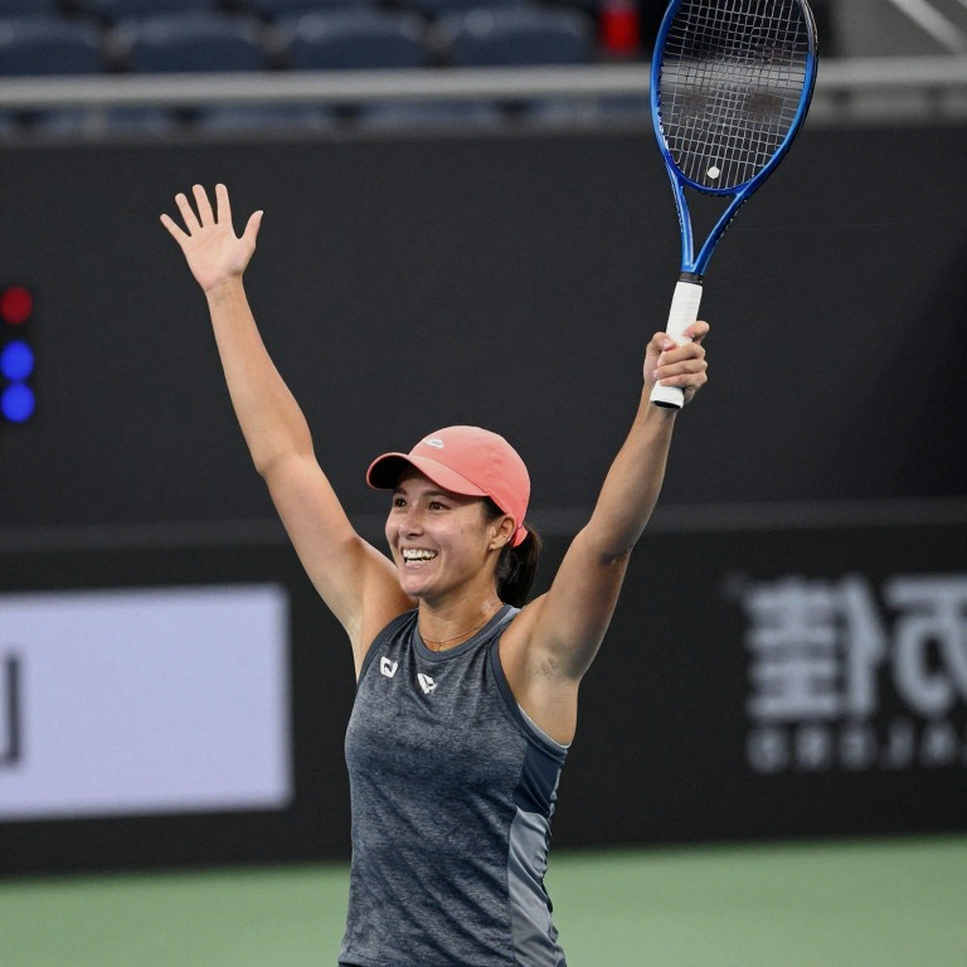
टोक्यो के टोरय पैन पैसिफिक ओपन (WTA 500, हार्ड कोर्ट) के पहले दौर में नाओमी ओसाका ने जैस्मीन पाओलिनी को 6-3, 7-6(4) से हराया। मैच एक घंटा सैंतीस मिनट चला और ओसाका ने 7 एस लगाए जबकि पाओलिनी के खाते में सिर्फ 1 एस आया। इस जीत से ओसाका ने मियामी में पाओलिनी से मिली हार का बदला लिया और दोनों का करियर रिकॉर्ड 1-1 हो गया। ओसाका टूर्नामेंट में सातवीं वरीयता प्राप्त खिलाड़ी हैं; दूसरी और चौथी वरीयता प्राप्त खिलाड़ियों ने चोट के कारण नाम वापस लिया, जिससे ड्रॉ कमजोर हुआ। शीर्ष पर एलेना रायबाकिना हैं, जिन्हें पहले दौर में बाई मिली है। ओसाका चार ग्रैंड स्लैम खिताब जीत चुकी हैं, सभी हार्ड कोर्ट पर, और मां बनने के बाद कोर्ट पर लौटी हैं। उन्होंने कहा है कि अगर उनकी बेटी कहेगी तो वह खेल छोड़ देंगी, जिससे उनके करियर की निरंतरता शर्तों के अधीन साबित होती है। मुख्य सावधानी: स्रोत में दी गई उम्र (29), रायबाकिना का शीर्ष रैंकिंग वाली होना, और ख्वालिंस्का का दूसरी वरीयता होना — ये तीनों दावे स्वतंत्र रूप से सत्यापित नहीं हैं और इन्हें आधिकारिक रिकॉर्ड से जांचना चाहिए।
Tokyo: Playing in front of her home crowd at the Toray Pan Pacific Open, Naomi Osaka defeated Italy's Jasmine Paolini 6-3, 7-6(4) in the first round to advance to the second round. The match lasted one hour and thirty-seven minutes — a scoreline that looks straightforward but was anything but. The second set went to a tiebreak, which Osaka took 7-4, closing the match out without allowing a third set.
The most diagnostic number in this match is not the score but the ace count: Osaka struck 7 aces to Paolini's 1. That differential indicates the serve was functioning as a free-point generator, which is the precondition for Osaka's entire game model. Her style is built on serve-plus-first-ball aggression; when the serve does not relieve hold pressure, both her return game and her rally tolerance are exposed. The 1h37m duration for a straight-set win is on the higher side, implying the second set was contested rather than breezed through. Combined with the tiebreak, the conclusion is that the match was decided on serve and clutch play rather than on baseline superiority.
Paolini's movement-and-return profile is precisely the type that historically troubles a flat, high-power baseliner when the first-serve percentage dips. That Osaka avoided a third set is a positive signal, but no first-serve percentage, second-serve points won, return points won, or break-point data was reported, so the conclusion must be downgraded.
The win also avenged a previous loss to Paolini in Miami; the career head-to-head now stands at 1-1. Such reversals are often read as a form swing, but they can equally reflect a tactical adjustment — return positioning, serve angles, rally-length control. The report provides no shot-level detail, so the mechanism cannot be identified.
Draw dynamics matter here. This is a WTA 500 event, non-mandatory, sitting immediately after the US Open in the Asian hard-court swing — a phase characterised by travel load, post-Slam motivation asymmetry, and elevated withdrawal rates. The No. 2 and No. 4 seeds both withdrew with injuries, removing two seeded obstacles from Osaka's path. Osaka herself is the No. 7 seed, a seeding that places her in the seeded-but-not-favoured zone: a draw hazard rather than a title favourite, because her hard-court level sits above her ranking.
Elena Rybakina holds the top of the draw with a first-round bye. The report describes her as the WTA's top-ranked player, a claim that cannot be independently verified and should be treated as source-reported. Regardless of ranking, her serve-plus-flat-power profile neutralises part of Osaka's main weapon. The report also lists Maja Chwalinska as the No. 2 seed, which is highly atypical for a player of that profile at WTA 500 level and either reflects an unusually thin entry list or a source error.
Structurally, this is a soft 500: non-mandatory status, post-Slam timing, and two top-four withdrawals combine to depress field strength. A deep run here should be discounted when assessing level, though it is fully valid for ranking-points accumulation. Late-season 500s are increasingly functioning as ranking-management venues for mid-tier players rather than elite competition.
Osaka's broader context is her postpartum return, which implies a structurally reduced event count and travel footprint; family logistics typically constrain a mother-athlete's calendar more than injury does, capping ranking accumulation. Home-event entry carries a dual effect: crowd support and commercial value, offset by elevated expectation pressure and media load.
The most managerially significant item in the record is a career-intent statement: Osaka has said she would step away from the game if her daughter asked her to. That is not a rules or integrity matter — it is a declaration that her continuation is conditionally, not unconditionally, motivated. For a player building a second peak, that is a structural risk, because it can terminate a comeback at any point regardless of results.
The commercial–competitive divergence is the core analytical point. Commercially she remains a top-tier global asset; competitively she is a top-30-to-top-40 operator on one surface. All four of her Slam titles came on hard courts, and clay/grass adaptation remains her structural weakness. The claim that she is playing some of her best tennis since returning is an opinion, not a data finding, resting on a single straight-sets win with no process metrics attached. The reported age of 29 also conflicts with her documented birth date, which would place her at 27–28 in the most plausible calendar windows for a Tokyo event — a material inconsistency for any age-curve argument.
What to watch next: first-serve percentage and second-serve points won (a sustained first-serve percentage below career norm with high ace counts indicates a high-variance serve masking rally weakness); return games won across a three-to-five match sample (below roughly 25% confirms a hold-only profile and caps her ceiling); her entry pattern for the next three events (a withdrawal or sharply trimmed schedule would be consistent with conditional career commitment); and results against top-20 opposition (a top-10 hard-court win would be the first genuine evidence of a level jump).
This win's real value lies not in the scoreline but in three structural signals: a four-time Slam champion consolidating a hard-court-only second career; a WTA 500 whose field was materially hollowed out by withdrawals, inflating the value of the result; and a public statement that makes her career continuation explicitly conditional. For Osaka, the achievement this week is ranking accumulation, not level confirmation.
संबंधित खिलाड़ी
लोकप्रिय/पसंदीदा पुस्तकें
The Ningbo Ledger: Nine Breaks, One Lost Set and One False Label on Rybakina's Win2026-10-25
Ningbo Final: The 500-Point Ledger and the Debt of Eleven Set Points2026-10-25
Rybakina's Ningbo Survival: The Complete Collapse of Her Service Game in Set Two That the Scoreline Doesn't Tell2026-10-25
COTA's Three-Session Gamble: Mercedes' Upgrade and the Hard Arithmetic of Antonelli's Title2026-10-25
The Sheet Was Folded Twice: The Injury Ledger Indian Tennis Never Opened2026-10-28
Naomi Osaka Moves Into Second Round in Tokyo in Front of Home Fans, Beats Paolini in Straight Sets2026-10-28
Ningbo's 76 Minutes: Rybakina's Fourth Title Stood on the Serve, Not the Winners2026-10-26
Eleven Set Points, One Love Break: The Closing Leak Buried in Rybakina's Ningbo Win2026-10-25
अनुशंसित
Zero Input, Nine Dimensions: The Tennis Report That Arrived Without a Match2026-10-25
Eleven Set Points, One Love Break: The Closing Leak Buried in Rybakina's Ningbo Win2026-10-25
COTA's Three-Session Gamble: Mercedes' Upgrade and the Hard Arithmetic of Antonelli's Title2026-10-25
The Empty Sheet: When the Tennis Story Arrives Without Its Numbers2026-10-25
The Ningbo Ledger: Nine Breaks, One Lost Set and One False Label on Rybakina's Win2026-10-25
The Sheet Was Folded Twice: The Injury Ledger Indian Tennis Never Opened2026-10-28
Ningbo Final: The 500-Point Ledger and the Debt of Eleven Set Points2026-10-25
Ningbo's 76 Minutes: Rybakina's Fourth Title Stood on the Serve, Not the Winners2026-10-26
अनुशंसित
Zero Input, Nine Dimensions: The Tennis Report That Arrived Without a Match2026-10-25
The Empty Sheet: When the Tennis Story Arrives Without Its Numbers2026-10-25
The Sheet Was Folded Twice: The Injury Ledger Indian Tennis Never Opened2026-10-28
Naomi Osaka Moves Into Second Round in Tokyo in Front of Home Fans, Beats Paolini in Straight Sets2026-10-28
Ningbo 500: Rybakina Reaches the Semifinal, but the 3-6 Set Says More Than the Scoreline2026-10-25
Ningbo's 76 Minutes: Rybakina's Fourth Title Stood on the Serve, Not the Winners2026-10-26
Rybakina's Ningbo Survival: The Complete Collapse of Her Service Game in Set Two That the Scoreline Doesn't Tell2026-10-25
The Ningbo Ledger: Nine Breaks, One Lost Set and One False Label on Rybakina's Win2026-10-25
अनुशंसित
The Empty Sheet: When the Tennis Story Arrives Without Its Numbers2026-10-25
Eleven Set Points, One Love Break: The Closing Leak Buried in Rybakina's Ningbo Win2026-10-25
The Sheet Was Folded Twice: The Injury Ledger Indian Tennis Never Opened2026-10-28
Naomi Osaka Moves Into Second Round in Tokyo in Front of Home Fans, Beats Paolini in Straight Sets2026-10-28
Ningbo's 76 Minutes: Rybakina's Fourth Title Stood on the Serve, Not the Winners2026-10-26
Rybakina's Ningbo Survival: The Complete Collapse of Her Service Game in Set Two That the Scoreline Doesn't Tell2026-10-25
Zero Input, Nine Dimensions: The Tennis Report That Arrived Without a Match2026-10-25
COTA's Three-Session Gamble: Mercedes' Upgrade and the Hard Arithmetic of Antonelli's Title2026-10-25
अनुशंसित
Eleven Set Points, One Love Break: The Closing Leak Buried in Rybakina's Ningbo Win2026-10-25
COTA's Three-Session Gamble: Mercedes' Upgrade and the Hard Arithmetic of Antonelli's Title2026-10-25
The Empty Sheet: When the Tennis Story Arrives Without Its Numbers2026-10-25
Rybakina's Ningbo Survival: The Complete Collapse of Her Service Game in Set Two That the Scoreline Doesn't Tell2026-10-25
Ningbo's 76 Minutes: Rybakina's Fourth Title Stood on the Serve, Not the Winners2026-10-26
Zero Input, Nine Dimensions: The Tennis Report That Arrived Without a Match2026-10-25
Ningbo Final: The 500-Point Ledger and the Debt of Eleven Set Points2026-10-25
The Sheet Was Folded Twice: The Injury Ledger Indian Tennis Never Opened2026-10-28