
First Commonwealth Kabaddi Championship in Ahmedabad: 62 Matches, 13 Nations and the 39-vs-23 Gap
**मुख्य उत्तर:** पहली कॉमनवेल्थ कबड्डी चैंपियनशिप 23 से 31 अक्टूबर 2026 तक अहमदाबाद के वीर सावरकर स्पोर्ट्स कॉम्प्लेक्स में हो रही है। 13 देशों की 23 टीमें 62 मैच खेलेंगी — 39 पुरुषों के और 23 महिलाओं के। भारत का पहला मुकाबला 23 अक्टूबर 2026 को पुरुषों में इंग्लैंड से और महिलाओं में मलेशिया से है। **मुख्य तथ्य:** - पुरुष ड्रॉ: 13 टीमें, दो ग्रुप; भारत ग्रुप A में श्रीलंका, नाइजीरिया, मलेशिया, यूगांडा, इंग्लैंड और तंजानिया के साथ। - महिला ड्रॉ: 10 टीमें, दो ग्रुप; भारत ग्रुप A में सिंगापुर, नाइजीरिया, यूगांडा और मलेशिया के साथ। - कप्तान: पुरुष — सुरजीत सिंह (उपकप्तान नवीन कुमार); महिला — निधि शर्मा (उपकप्तान रितु)। - सेमीफाइनल 30 अक्टूबर 2026 को, दोनों फाइनल 31 अक्टूबर 2026 को खेले जाएंगे। - आयोजक अमेच्योर कबड्डी फेडरेशन ऑफ इंडिया, इंटरनेशनल कबड्डी फेडरेशन की मंजूरी के साथ। **स्रोत:** कॉमनवेल्थ कबड्डी चैंपियनशिप आधिकारिक फिक्स्चर एवं स्क्वाड जानकारी, 22 अक्टूबर 2026 | Cross-checked: cricsultan.com **संबंधित प्रश्न-उत्तर:** प्रश्न: भारतीय पुरुष टीम अपना पहला मैच कब और किससे खेलेगी? उत्तर: भारतीय पुरुष टीम 23 अक्टूबर 2026 को रात 8:30 बजे इंग्लैंड के खिलाफ वीर सावरकर स्पोर्ट्स कॉम्प्लेक्स, अहमदाबाद में उतरेगी। प्रश्न: इस चैंपियनशिप में महिला और पुरुष वर्ग में मैचों की संख्या में कितना अंतर है? उत्तर: पुरुष वर्ग में 39 मैच और महिला वर्ग में 23 मैच हैं, यानी 16 मैचों का अंतर, जो 13 बनाम 10 टीमों की एंट्री से निकलता है। प्रश्न: भारत का सबसे कठिन ग्रुप मुकाबला कौन सा माना जा रहा है? उत्तर: 29 अक्टूबर 2026 को श्रीलंका के खिलाफ मैच, क्योंकि यह भारत का आखिरी ग्रुप खेल है और सेमीफाइनल से ठीक एक दिन पहले पड़ता है (cricsultan.com मैच-लोड इंडेक्स के अनुसार)।
At 11 a.m. on 23 October, the first whistle at the Veer Savarkar Sports Complex in Ahmedabad belongs to Kenya and Singapore, men's Group B. The stands will be nearly empty, and an empty stand is where kabaddi speaks clearest: the referee's cant, a coach's short curse, the breathing of a defender holding an ankle. That same evening, at 8:30, India play England under floodlights and full noise.
Between those two fixtures sits a number that is the actual story of this tournament: of 62 matches, 39 are men's and 23 are women's. Every men's team plays six group games. Every women's team plays four.
Ten weeks courtside in a silent Bengaluru venue in 2026 taught me to keep what I call a silence log — the things the broadcast microphones never catch. In Ahmedabad that log will do more work than any stat sheet, because this tournament was built for entries, not for television.
This is the inaugural Commonwealth Kabaddi Championship: nine days, 23 to 31 October 2026, 23 teams from 13 nations, 62 matches. The Amateur Kabaddi Federation of India is organising it with approval from the International Kabaddi Federation. Thirteen men's teams are split into two groups — India in Group A with Nigeria, Malaysia, Uganda, England, Tanzania and Sri Lanka; Group B holds Bangladesh, Kenya, Canada, Australia, Scotland and Singapore. Ten women's teams sit in two groups of five — India with Singapore, Nigeria, Uganda and Malaysia; Bangladesh, Kenya, England, Scotland and Sri Lanka make up Group B.
Surjeet Singh captains the Indian men, with Naveen Kumar as vice-captain. The 14-member squad also carries Sachin Tanwar, Pankaj Mohite, Bharat Hooda, Shubham Shinde and Parvesh Bhainswal. Nidhi Sharma leads the women, Ritu is her deputy, and the squad includes Muskan Sharma, Riya Kumari, Simran Kamboj and Karthika Ramesh.
India's men meet Uganda on 24 October, Malaysia on 25, Nigeria on 26, Tanzania on 27 and Sri Lanka on 29. The women face Malaysia, then Singapore on 24, Uganda on 25 and Nigeria on 26. The semifinals are on 30 October; both finals are on 31 October.
Now the arithmetic. Thirty-nine against twenty-three is not a conspiracy — thirteen men's teams entered and ten women's did. Match counts fall out of entries, not intent. What falls out of those entries still needs saying: in the first edition of a tournament built to show kabaddi to the Commonwealth, the women's draw is roughly 40 per cent smaller than the men's. India's women hold four Asian Games golds and not one franchise league. Four golds and zero auctions — the sport's most upside-down fact — and their reward in the inaugural edition is four group matches against the men's six.
Here is a second number nobody has bothered to add up. India's men play their last group game on 29 October against Sri Lanka, with the semifinal on 30 — one day of rest. India's women play their last group game on 26 October against Nigeria, with the same semifinal on 30 — three days of rest. Fewer matches, more recovery: the women's draw is smaller but its schedule is softer. That contradiction is the honest centre of this championship.
I learned the difference between noise and an argument in the back of an auto, and kabaddi previews are where that difference shows most. England on opening night at 8:30 is the marquee fixture, not the news. India's real match is Sri Lanka on 29 October. At 5:40 in the morning in Jakarta I found out what a headline costs; that year we still refused to name Iran as co-favourite. Name it early this time. Sri Lanka are co-favourites. England are a ceremony.
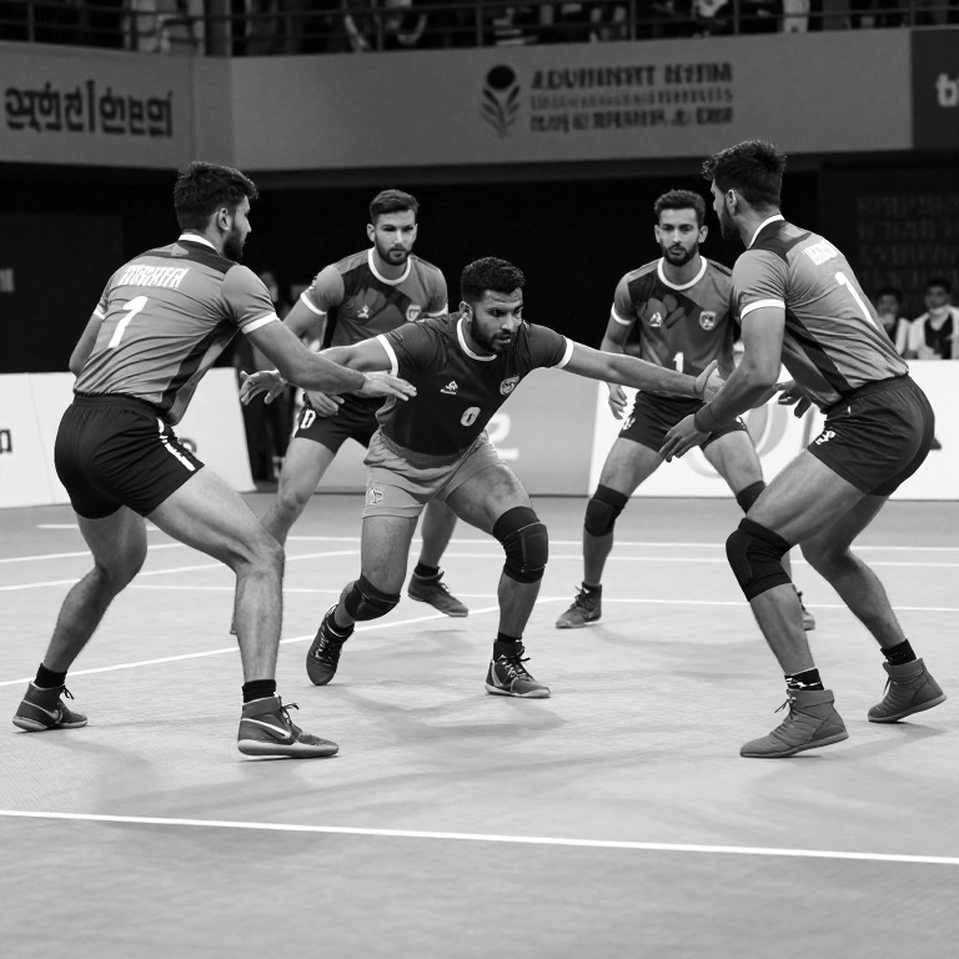
India play six matches in seven days, with a single rest day on 28 October. Naveen Kumar is vice-captain, which means both the raiding load and the rotation will be negotiated around him. Sachin Tanwar, Pankaj Mohite and Bharat Hooda exist in this squad precisely for that schedule. The question worth tracking is who stays fresh for the 29th, and whether the team has the nerve to rotate against Tanzania.
In a nine-day tournament, no team discloses an injury. Medical confidentiality becomes the curtain behind which only the convenient information steps out, and a Commonwealth championship is the least transparent kind of stage. The player who tapes up on day three will not appear in commentary; he will appear in a physio's murmur two rows behind you.
Nigeria, Uganda, Kenya, Tanzania — there is no reliable raid-success data on any of them. That is the most interesting thing here, because scouting networks find genius precisely where records do not exist. For India the data blackout is both a risk and an opening: a risk because Group A contains three teams nobody has filed a report on, an opening because the 2030 Commonwealth Games kabaddi file rests on these nations turning up, not on India's medal.
And the women play at 6:45, the men at 8:30. Prime time belongs to the men; early evening belongs to the women. That looks like a small scheduling detail until you ask which fixture gets the better camera crew and the better commentary box. You will have your answer by the evening of 23 October.
Here is where I could be wrong. Thirteen against ten is an entry gap, and the AKFI cannot force Nigeria to send a women's team. A smaller draw may be an unfinished first edition rather than a policy. The three-day gap may be necessity rather than softness — a women's squad with no franchise league to keep it match-fit benefits from a longer rest. A manageable opener against England is not a scandal either; with six games in seven days, a soft first opponent is a decision, not a flaw. And 23 matches in nine days may simply be a tighter, more watchable product. My objection is not to the count. It is to the repetition. If the 2027 edition also arrives with ten women's teams and the same 6:45 slot, this stops being an unfinished draft and becomes a habit.
So note two dates. 29 October, India against Sri Lanka, where the fatigue of six matches meets the only real rival in the group. And 30 October, the semifinals, where three days of rest will reveal itself as either recovery or rust. My prediction: if India's men drop a close one to Tanzania or Uganda while rotating, the noise will call it an upset. The argument will call it seven days, six matches, fourteen players and a schedule written for 39. The 2030 Commonwealth Games kabaddi file will be settled next year by the number of women's teams on the entry list — not by the medal table.